Monday, 30 January 2017

Sunday, 29 January 2017
#SproutChat Calendar: Upcoming Topics for February 2017
It’s hard to believe that we’re days away from February 2017! We hope that you’re progressing toward your goals quickly by taking the time to read, learn and connect with industry colleagues. #SproutChat is the perfect place to gain new insight and keep your social strategies moving forward. Just jump on Twitter every Wednesday from 2-3 p.m. CST to learn and share best practices about social media marketing and community building.
Check out the topics we’ll cover this month and be sure to click “Add to Calendar” for the weekly Twitter chats that you don’t want to miss. Are none of the discussions catching your eye? Feel free to discuss your own social media wins and pain points in our Facebook community.
February 1, 2017: Managing Social Media on the Go
Sprout Product Focus: Mobile App
Consumers expect quick responses via social media. That means social media managers must be present and responsive 24/7. How can they maintain this level of service? With great mobile apps, of course. Join us for a discussion about best practices for managing social on the go.
Add to Calendar: Outlook • Google • Yahoo • Outlook.com • Apple Calendar
February 8, 2017: How to Grow Your Business
Getting a business up and running is one thing, but maintaining and growing it is another. Join us for an insightful #SproutChat discussion with Sprout All Star and Owner of Social Media Unicorn, Krista Whitley. Krista joins our discussion with years of experience and expertise in growing her Las Vegas-based agency and personal brand.
Add to Calendar: Outlook • Google • Yahoo • Outlook.com • Apple Calendar
February 15, 2017: Discussing Marketing Success With Evernote
Social media marketers have a plethora of tools in their tool box. One of the tools many marketers rely on to nurture and share ideas and increase productivity for their team is Evernote. This week, Lolitta Gevorkova, Social Media Specialist at Evernote, will be joining our discussion to talk about getting the most out of Sprout’s platform and what quantifies as success on social.
Add to Calendar: Outlook • Google • Yahoo • Outlook.com • Apple Calendar
February 22, 2017: Creating a Good Video
If you haven’t caught on that video needs to be an essential component of your social media strategy, you’ve been living under a rock. So why aren’t more brands embracing video content? When it comes to video and social there are definitely challenges ranging from quality to consistency. Today, we’ll discuss common challenges and offer solutions for producing more effective video content.
Add to Calendar: Outlook • Google • Yahoo • Outlook.com • Apple Calendar
This post #SproutChat Calendar: Upcoming Topics for February 2017 originally appeared on Sprout Social.
source http://sproutsocial.com/insights/sproutchat-calendar-february-2017/
Friday, 27 January 2017
Thursday, 26 January 2017
Google’s Biggest Search Algorithm Updates Of 2016
The year 2016 packed quite a punch as far as Google’s search algorithm updates were concerned, with several updates, big and small, being rolled out. While some updates were conspicuous and caused a stir, others were discreet. However, smart marketers had their eyes and ears open to make the most of them.
Among the most noticeable and impactful updates were the Penguin and the Possum, both of which help websites improve their credibility. While Penguin checked websites for spammy content, Possum made a difference by filtering out business listings on Google My Business from the Local Pack and Local Finder.
Penguin was geared towards crawling websites to weed out and penalize those that harbored spammy content. It went on to become Google’s core ranking algorithm. However, Penguin was kind to the websites that rectified this error. Their rankings improved once the pages were re-crawled after the rectification.
Also, because of the update, the algorithm penalizes only the pages that contain spammy content, instead of the entire website. This has been done in an effort to devalue spam and promote authenticity in Web content.
Google also announced an algorithm update to make the digital landscape more mobile-friendly. This aim of this update was to improve ranking signals for pages that users found useful and mobile-friendly. This was important because whenever the search algorithm is changed, it has far-reaching effects on search results across devices. The updates are made so that users can find what they’re looking for quickly and easily.
Being aware of the 2016 updates means you will be able to steer your way in 2017 with more confidence. You will know the effects of algorithm changes on website rankings, which will help you channel your SEO efforts in the right direction, thereby augmenting your website’s ranking. If your SEO practices are sound and in keeping with the updates, you will not have much to fret over.
This gifographic describes all the notable Google search algorithm updates of 2016 as they happened. Whether it was the core algorithm update, AdWords placement, Possum update, or the return of the Penguin, it represents everything that made waves in the year gone by.

The post Google’s Biggest Search Algorithm Updates Of 2016 appeared first on Ninja Outreach.
source https://ninjaoutreach.com/google-algorithm-updates/
Wednesday, 25 January 2017
How to Win at Content Marketing in 12 Turns
Content marketing is the trend of this decade. Entrepreneurs work on sharing their knowledge with readers with the hopes that readers, in their turn, would be impressed enough to happily line up to the cashier.
But when it comes to putting content marketing into action, for some reason, many of us give up.

The reason is actually understandable as, in fact, content marketing is not at all that romantic. It is repetitive, back-breaking research, goal setting, forecasting, planning, along with scrupulous adherence to the plan, production, and promotion.
In this article, I will describe the basic steps that clarify what principles to use when building a content marketing strategy.
Describe Your Target Audience
You probably heard many times that content is king. But is it really so? To my mind, it’s not, as the real king is the client. Your content strategy should be built for your target client.
Imagine clearly who exactly your customer is. Mark his needs, fears, and desires. Separate your target audience by segments, and define a typical algorithm for finding information for each: what customers are looking for, and where.
Formulate The Key Messages
While formulating key messages for each customer segment, you should rely on the needs, fears, and goals that you have recorded in the first step. Select a typical problem of the segment and describe how you solve it, and then squeeze the description into one sentence.
These are the basic ideas which will become the foundation for all your content marketing. It is desirable to express these ideas in 1-2 phrases or even in the form of a slogan. But do not confuse this with the slogan of the company. A communication slogan describes your content, not your product.
It is also important to remember two things:
- Do not talk about yourself. Do not say that you are an expert. What to talk about? That's right, about how to solve the problem of your customer.
- Do not create the content for the sake of the content.
Formulate The Mission
Every organization needs a mission, as it will be the main basis or ideology for your content marketing.

To formulate the mission, you can answer a few simple questions:
- What do we do? (What kind of business are we in?)
- For whom do we do it?
- Where geographically do we do it?
- How do we do it? (What makes our business unique? What are our competitive advantages?)
- What don’t we do and won’t do in future?
Once you’re done, clearly specify and use your mission in every description of your profile (in social networks, in the 'About us' page, and so on).
Set Goals
Define and fix your goals. The goals of your content marketing can be very different. Yeah, of course, to increase brand awareness, customer loyalty and, as a consequence, increase in sales. But goals should be specific and measurable.
For example, doubling Google organic traffic or increasing the number of subscribers to 50%.
Specify the current and desired indicators for each goal for a specific period, such as a year. Be sure to fix the methods and tools for measuring them. Use the five most important indicators. It would help to keep a finger on the pulse to not get lost in the data volume.
Analyze Your Competitors’ Actions
Define your main competitors. To make your life easier, use tools like Serpstat, with their advanced competitor research module, or SimilarWeb (assuming that you haven’t already done that, of course).

Your competitors in content marketing will not only be the companies with a similar offer. Some of them also compete with you for content recognition. There are the different online media, information portals, blogs, and the like, that cover the same topics as you do.
Do a review of the content marketing activity of your competitors: how they represent themselves on social networks, blogs, thematic portals, etc., and make a list of the main topics and types of competitors' content.
Once you collect all the information about these competitors, it's necessary to understand how to act differently.
For example, if you tackle the same subject, try to change the format. If everybody writes articles about SEO, you can, instead, create a quick tutorial video detailing step by step instructions about how to check readership reaction to your SEO efforts.
Collect Keywords
A weirdly large number of content marketers do not carry out keyword analysis and are guided just by intuition or instincts. Don’t be one of these types.
A thorough keyword analysis lets you predict what is interesting to your audience even before they will tell you about it. Guided by correctly clustered semantic core, you can support your ideas with real data from the SERPs.
Find Your Customers On The Social Networks
Find 5 accounts of your already existing clients.

The found profiles should be analyzed, to understand what kind of content these people share, what they write about, what their psychological drivers are, and what they are interested in, generally. Then, arrange this list of topics by popularity.
Highlight The Main Topics
Identify key topics of interest for each group of clients; these are the main topics of your content marketing.
So how do you find out what their key problems are? Simple. Just ask! For example, you can arrange a survey in your newsletter. If you have a sales department, talk to them. Find out your audience's problems. Communicate with customers in social networks (where it is usually easier to do).
Just do not try to invent the target audience's problem yourself. Nothing good will come out of it.

Make Headers Templates
Draft your article headers in advance. This will set you on the right track for writing your next piece.
For example:
- Tools and Techniques of Graphic Design
- Develop Yourself in Graphic Design: a Guide to the Use of Essential Tools and Techniques
See the difference?
Tone Of Treatment
Determine the tone that you will use to communicate on behalf of your product. Correct tone gives the company its own identity when stacked up against its competitors. To set the tone, try to ask yourself the following questions:
- If your business was a person, what type of person would he be?
- What is the relationship between him and a client (coach, friend, mentor, etc.)?
- What are the epithets he can’t be characterized with?
- How do you want your customers to perceive your business?
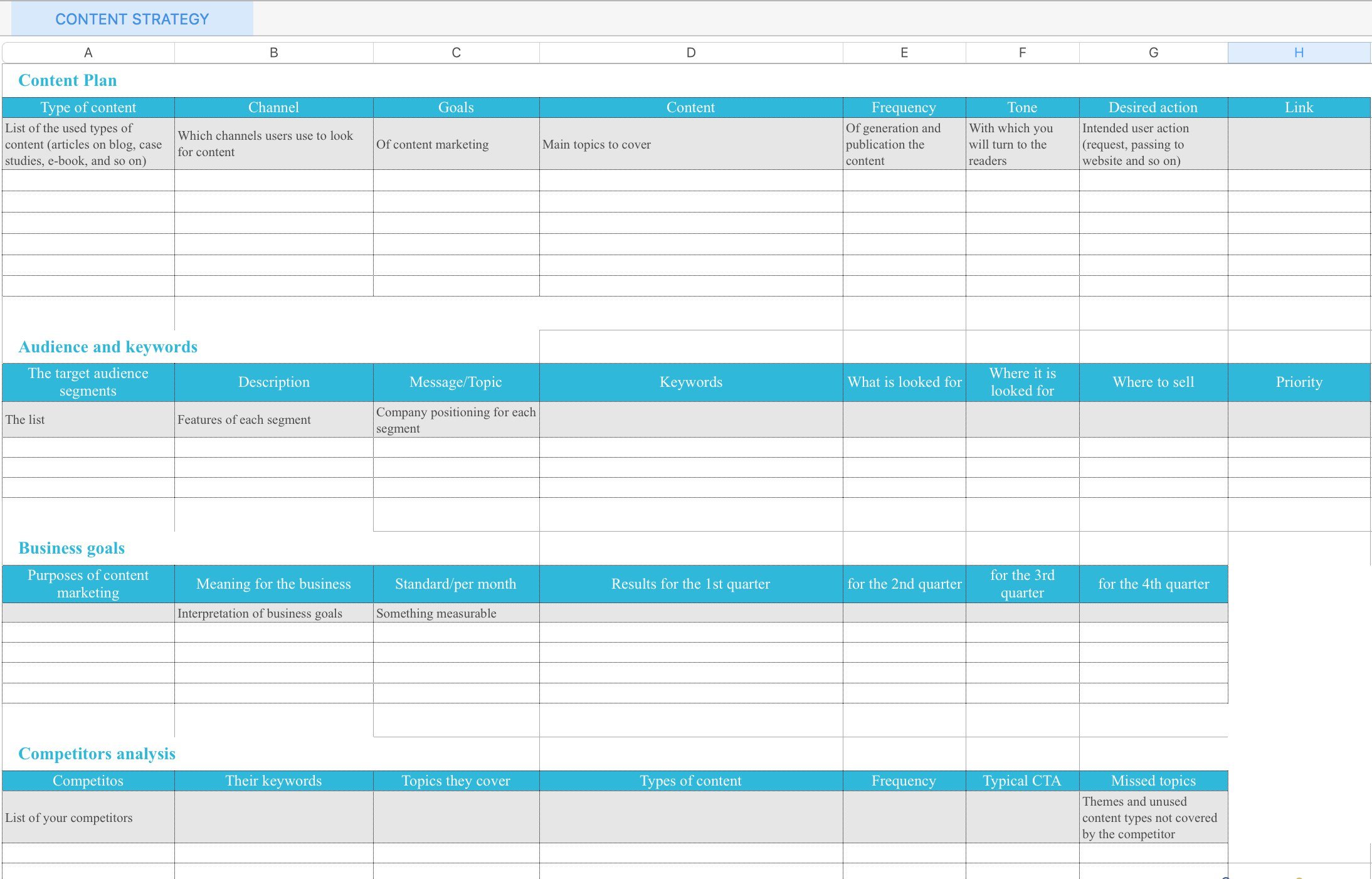
Fill The Content Map
The content map is a table with the distribution of types of content. Use the data collected in the previous steps to fill in the table. Specify:
- Content types in order of popularity among your target audience
- The used channels
- Goals
- Desired user actions after meeting with the content (should relate to objectives)
- Frequency of publication
- Basic content and topics
- Headline templates
- Tone of treatment
Where To Find New Ideas Every Day
Yes, I know about that eternal struggle called “What to write about?”. At first, there are so many fresh ideas but then the enthusiasm subsides and you feel that you’ve exhausted all the topics there are to write about.
But you always can bring your muse back.
First of all, ask your sales team, what questions your customers ask and what difficulties they are facing. Your response to these issues can form the basis for excellent new material.
The next source is your professional information field. Follow the specialized media, opinion leaders in the niche. Copying them is not necessary, but be sure to consider all new trends.
And then there are books, magazines, and blogs. You can also attend webinars, conferences, master classes. All this information will give you a good foundation to grow your own ideas.
Also, try Google Trends, which is a nice (and free) way to look for inspiration. By listing what is hot right now, and showing you what has been hot before, this handy web app can give you great ideas on what creative direction you want to head in.
But honestly, to my mind, it doesn’t work much for blogs with clearly bounded topics. Even selecting a Category and location gives a pretty wide range of results, so you still have to be lucky to get something related to your niche.

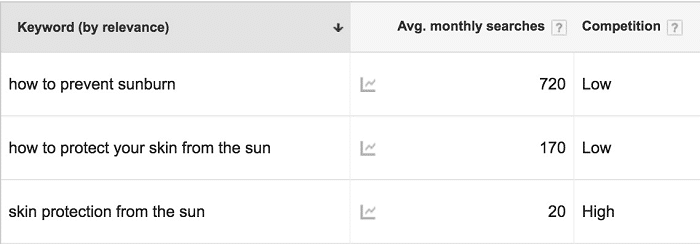
My favorite way to find out what your potential customers are interested in is Serpstat. This SEO tool has recently rocked on ProductHunt with its feature for Content Marketers that helps to identify SERP trends and find the relevant questions in the form users search for them. You can then create content that contains the users’ most frequently used phrases.
But first of all, it gives tons of inspiration

Gather Your Content Marketing Strategy
After all this work, you need to combine the results of the previous steps into one big document. And it should look something like this (the image is clickable):
What’s Next?
This is just the beginning. You will still have to create and distribute cool content regularly, collect web analytics data and feedback from readers, edit your strategy, and plan again if necessary.
But if you consistently performed all the previously marked steps, then you're already holding a clear guide that gives meaning and direction to all further processes, and that helps to make content marketing effective.
So, good luck! And if you have anything else you’d like us to add to this article, please share it with us in the comments section below.

The post How to Win at Content Marketing in 12 Turns appeared first on Ninja Outreach.
source https://ninjaoutreach.com/how-to-win-content-marketing/
Tuesday, 24 January 2017
Why Republishing Content on Medium Is A Great Idea And How to Do That
Have you been writing a lot?
Feels like posting daily on your site makes your content simply go to waste?
Have you been trying hard to publish your content on a platform where your post can get the more attention?
If that is so, then maybe it’s time to republish your content.
Yes, you heard it right. I am talking about republishing content.

You see, you have to understand that content marketing can be a slow process and sometimes you have written some high-quality posts that do not get the attention that you need.
That is when you should be republishing content, and that's where Medium or other such platforms come in.
Republishing is usually done with a little tweaking in the title and order, maybe. But mostly, the content is the same, which makes it extremely easy to do.
BONUS: Check out this post full of deep insights about republishing on Medium
Breaking The Myth of Duplicate Content
One complication that usually arises with republishing content is the fear of getting penalized for "duplicate content." Some people think that republishing content will result in a Google penalty for duplicate content, but this is not the case anymore.
If the content is republished on the same site, again and again, that might indeed become an issue. But if you republish your content on different sites with different titles, then that won’t be as much of an issue, as far as Google Rankings are concerned.
Some say that if you republish the same post again, your Google ranking will get affected.
But that no longer applies to every instance. The truth is, your Google Rankings will not get affected.
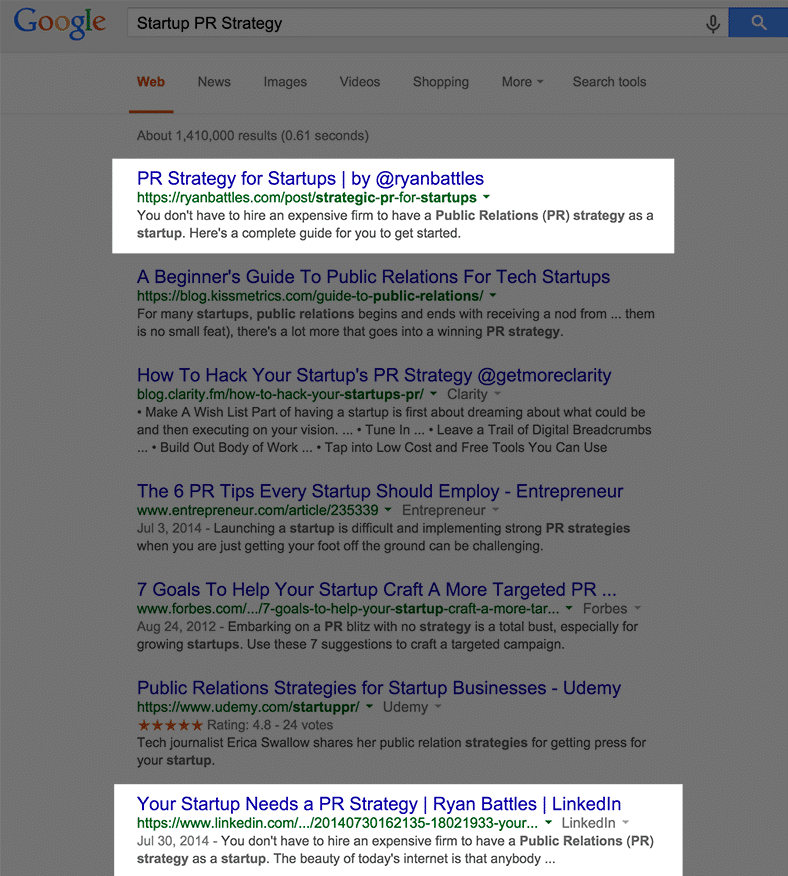
For instance, when this post, "Startup PR Strategy," was republished on LinkedIn with a different title, the latter remained down in ranking.
Going to back Medium, there is no doubt that it is one of the platforms where you get the best chance to republish your content with some of the best strategies that I am going to explain as we move on.
Let’s first check out some best practices for republishing content.
3 Things to Do When Republishing Content
- Change Your Headline
The most important thing is to change your headline or title when republishing. This will give a totally new look to your post.
Having creative headlines gives a boost to your post in any case, whether it’s publishing or republishing. Headlines grab the reader's attention very quickly. No wonder creating catchy headlines is an art.
As far as Medium is concerned, along with its unique font styles and various picture alignments, it also encourages writers to have interesting and attention-grabbing headlines.
Medium publishes stories, so its titles are geared for story-telling. This title, “Dear People Who Live in Fancy Tiny Houses,” for example, is strange, yet catchy at the same time.
- Use New Keywords When Republishing
Another strategy is to use different long tail keywords in different places. This will increase your reach as the same content will appear for more than one long tail keyword.
What does this mean?
This means that your content will start appearing in more search results. As we all know, every person defines pain points through a variety terms. That is, people search for articles using a variety of keyword combinations, so this strategy will allow you to rank for other related search terms.
This post on how to find related long tail keywords.
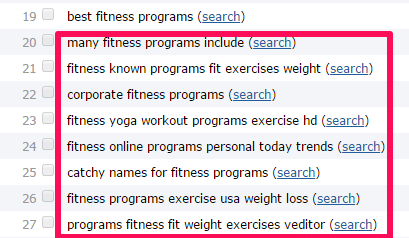
Below is one example of how one niche can have different long tail keywords. Now, this clearly explains how you can name an article differently when republishing.
- Republish to a Certain Limit
You have to keep one thing in mind while republishing and that is, “Do Not Republish Everything.” Yes, the statement is quite self-explanatory.
Republishing your content is a good option to make your content circulate more and increase your website traffic.
But keep in mind that you need to keep some blog posts as well.
Don’t republish everything because this will create problems for yourself.
How is that, you ask?
When you direct your audience to your original website, your website should have some unique content that has not been shared anywhere else. This will show that you have enough unique content to show your visitors, and this is the reason why you should republish but only up to a certain limit.
Now let's move on to the basic reasons on why you should adopt the idea of republishing content.
I know there must be some doubts in your mind that you shouldn’t do this, but let me tell to you about the other perks of republishing your content.
Here are 3 Major Reasons Why You Should Republish Your Content On Medium:
- High Exposure
Research shows that even the most successful sites get only around 100 visitors per day but on Medium, the scenario is totally different. Medium is one of the fastest trending social media platforms and the best part is that it gets 800+ daily visitors.
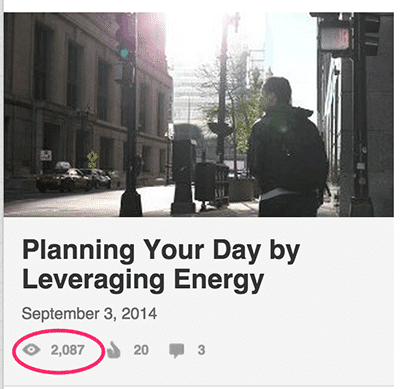
This means you will be getting higher views if you republish content on Medium. As an example, this post had 224 views upon its first publication on its original site. But as soon as the author republished it on Medium, the views went up to 2,087, which is quite a high number.

- Boost Traffic to Your Own Site
Another benefit of republishing on Medium is the imminent boost to your own site’s traffic.
When republishing on other platforms, put your site’s link at the end of your post so that people can click and get redirected to your site if they really like your work; hence, bringing in more traffic.
- Turn Your Name into a Brand
Turning your name into a brand is one of the most important things these days, especially when you are a writer. People recognize your words through your name.
Compared to LinkedIn or Twitter, Medium has the highest content circulation. Through this portal, you have the best chance at making your small brand renowned.
Conclusion
There can be no disagreement with the fact that creating content is a tough job, especially when you have to create quality content that is interesting at the same time.
People invest so much time in creating content all around the world.
But the sad reality is that not all posts get the attention it deserves. So to give that post the required attention, you need to repost it somewhere else, which is absolutely fine!
So, I hope this post has made you agree that republishing on Medium will benefit your site and yourself as a writer, too.
Keep reposting your great content and make your every word count through Medium
The post Why Republishing Content on Medium Is A Great Idea And How to Do That appeared first on Ninja Outreach.
source https://ninjaoutreach.com/why-republishing-content/